Understand New York City’s Building Emissions Law and Get Free Help
Nearly 70% of New York City’s carbon emissions come from the fossil fuels used to heat, cool, and power our buildings. Local Law 97 (LL97) is a signature part of the city’s plan to address climate change and make New York City carbon neutral by 2050. The law went into effect in 2024, and sets annual carbon emissions caps on most buildings over 25,000 gross square feet, with significant fines for non-compliance.
Strategies to reduce building emissions include making improvements that increase energy efficiency, introducing distributed energy resources and switching away from fossil fuels for heat and hot water. NYC Accelerator offers free assistance with energy efficiency and renewable energy upgrades. We’ll help you cut your building’s emissions and energy costs, comply with LL97 on time, and avoid annual fines.
Hear from a co-op board president who worked with our program to achieve LL97 compliance through 2035.
What is Local Law 97?
New York City enacted Local Law 97 (LL97) in 2019, which establishes carbon emission limits for most of the city’s largest buildings.
Most buildings covered by Local Law 97 will have to comply with what’s known as the Article 320 pathway: an annual carbon cap set on the emissions coming from energy use in their buildings. Covered buildings that exceed annual emissions limits will face an annual financial penalty of $268 per ton of CO2 equivalent over the limit set for their building in that year. Emissions are calculated based on tons of CO2 equivalent per square foot.
Some buildings have a less strict set of requirements. The law’s Article 321 pathway primarily applies to certain types of affordable housing, buildings with more than 35% rent regulated units, and houses of worship. These buildings are required to either a) complete one time completion of a list of 13 prescriptive energy conservation measures, or b) meet their buildings 2030 carbon emissions limit.
When does Local Law 97 come into effect?
The first LL97 compliance period began in 2024. Stricter limits will be phased in over time starting in 2030, and drive towards a net-zero limit in 2050. The first reporting year began in 2025, reflecting the carbon emissions from covered buildings in 2024. Based on publicly available benchmarking data from 2024, less than 10% of properties exceeded their cap for the first 2024-29 compliance period. Based on data from that same year, approximately 57% are projected to exceed limits for the 2030-2034 period.
What buildings does Local Law 97 apply to?
How do you know if your building is covered by Local Law 97?
The square footage of a building as it appears in the NYC Department of Finance (DOF) records determines whether it is subject to LL97. Tax lots are identified by a unique number known as a borough-block-and-lot (BBL), and there may be multiple buildings on a BBL. A Building Identification Number (BIN) uniquely identifies each building on a BBL. LL97 applies to each BIN on a BBL where the buildings individually or together meet the square footage threshold noted above. LL97 penalties are applied at the BIN basis. In other words, the law and associated penalties for non-compliance apply to each building on a tax lot.
Owners can refer to the Covered Building Lists (CBL) published by the Department of Buildings (DOB) to determine whether they must comply with Local Law 97 and which compliance pathway to follow. See the NYC DOB website to access the most up-to-date CBL and for information.
As of 2025, covered buildings are required to submit their annual greenhouse gas (GHG) emissions to the New York City Department of Buildings (DOB) by May 1 each year. These reports will reflect the building's energy usage from the prior year (e.g., reports submitted in May 2025 reflected 2024 usage). These reports must be submitted through the DOB’s online portal and certified by a Registered Design Professional (RDP), such as a licensed engineer (PE) or a registered architect (RA).
To report your emissions, follow these three steps:
- Pay the Local Law 97 filing fee via DOB NOW.
- Share your building’s energy source data through the Energy Star Portfolio Manager (ESPM).
- Submit your report using the NYC Building Energy Analysis Manager (BEAM) portal with the help of an RDP.
The most recent guidance on the compliance report submission process can be found here. For further details on Article 320 and Article 321 reporting, refer to the information guide relevant to your building:
- 320 Buildings (Market-Rate Buildings)
- 321 Buildings (Affordable Housing and Houses of Worship)
While the annual LL97 reporting deadline is May 1, buildings are allowed a 60-day grace period to file by June 30. Failure to file your LL97 report on time may result in significant penalties.
For 2026: If additional time is needed to file LL97 reports, buildings may apply for a filing extension via the BEAM Portal by June 30, 2026 for a $60 fee. An extension gives owners until August 29, 2026 to file their reports.
Learn more about this extension:
DOB published three additional packages of rules to guide the implementation of LL97.
First Rulemaking Package (November 2022)
Download Full Rule Text | Download Rule Summary
- Assigned 60 property types according to Energy Star Portfolio Manager for Local Law 97 covered buildings. Originally, the law assigned building emissions limits according to 10 Building Code occupancy class groups. This change better tailors the law’s emissions limits to the variety of building energy uses across building property types.
- Set building emissions limits across all 60 property types and compliance periods to 2050 and beyond.
- Established an electricity coefficient for the 2030 compliance period that reflected city and state policy goals for greening the grid and supported building electrification.
- Clarified that renewable energy credits (RECs) could only be used to offset the emissions from a building’s electricity use, rather than from all fuel types.
Second Rulemaking Package (December 2023)
Download Full Rule Text | Download Rule Summary
- Clarifies the mechanics of enforcement and specifies penalties for noncompliance.
- Outlines penalty mitigation pathways, including what is considered a “Good Faith Effort” to comply with the law’s 2024 carbon limits.
- Establishes a new credit for early electrification work that building owners can apply toward emissions reduction targets.
- Describes reporting requirements and penalties for affordable housing and houses of worship under the law’s Article 321 prescriptive pathway.
- Provides additional guidance regarding requirements for meeting Local Law 88 of 2009, which addresses lighting upgrades and submetering.
Third Rulemaking Package (December 2024)
Download Full Rule Text | Download Rule Summary
- Establishes fees for lighting and submetering reports (Local Law 88) as well as for annual building emission reports and alternative compliance pathways (Local Law 97).
- Introduces a new offset for annual emissions, allowing buildings to purchase offsets supporting HPD-qualifying electrification projects at $268/mtCO2e, capped at 10% of the building’s annual emissions limit.
- Defines minimum efficiency criteria and favorable GHG coefficients during the first compliance period (2024-2029) for buildings using cogeneration systems, permitted before September 1, 2024.
- Details scenarios and procedures for buildings to adjust emissions limits due to external or financial constraints limiting the ability to achieve Local Law 97 compliance.
- Adds a new credential for energy auditors submitting Local Law 87 Energy Efficiency Reports (EER) and removes the requirement for building owners to pay outstanding penalties for previous EER non-compliance before achieving current compliance.
LL97 provides pathways for temporary adjustments to emissions limits for building owners who face external or financial constraints, allowing them to apply for adjustments based on specific criteria outlined in Rule 103-12. Eligible building owners can apply by working with the NYC Accelerator and an RDP to submit a 320.7 Adjustment Application as part of their LL97 compliance report, with deadlines based on the type of constraint.
See NYC Accelerator's adjustment guides for more information:
- 320.7 Adjustment Guide for 320 Buildings (Market-rate Buildings)
- 320.7 Adjustment Guide for 321 Buildings (Affordable Housing and Houses of Worship)
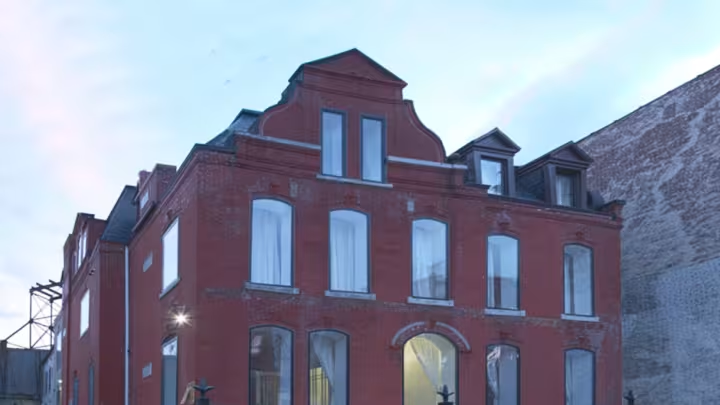
Local Law 97, Affordable Housing, and Houses of Worship
Learn more about Local Law 97's rules regarding affordable housing and houses of worship.

View impact on your building on Momentum
NYC Accelerator offers various pathways to help buildings comply on time and avoid fines. See your building's LL97 exposure on Momentum.
Speak to an LL97 Expert
Contact us and we’ll connect you to a dedicated expert who can provide personalized guidance tailored to your building’s unique needs.
Free Help with Energy Efficiency and Renewable Energy Upgrades
Resources for Local Law 97 Compliance
Look Up Your Building
Access Momentum to review building-specific LL97 information, including projected penalties and savings, project scoping, and retrofit management tool — all for free on Momentum.
Local Law 97 Summary
Get more information about LL97 and learn about the benefits of compliance.
Compliance for 321 Buildings
Under Article 321 of Local Law 97, affordable housing buildings may use alternative compliance pathways. See if this applies to your building(s) and review available incentives.
Beneficial Electrification Credit
Discover how you can leverage the beneficial electrification credit to comply with Local Law 97 and enhance efficiency.
Financing Energy Upgrades
Discover financing opportunities and work with an NYC Accelerator expert to identify the options that best fit your building's needs.
Incentives
Explore ways to cover the cost of building upgrades by reviewing our curated list of incentive programs, financing options, and tax credits available to New York City buildings.
NYC’s Department of Buildings
Understand the City’s plan for reducing greenhouse gas emissions and navigate LL97 upgrades and retrofit solutions that reduce emissions and maximize occupant comfort for your building.
Commercial Buildings with Central Heating & Cooling Systems
Guide to navigate LL97 upgrades and retrofit solutions for commercial buildings with central heating & cooling systems.
Commercial Buildings with Decentralized Heating & Cooling Systems
Guide to navigate LL97 upgrades and retrofit solutions for commercial buildings with decentralized heating & cooling systems.
Low-Rise, Pre-war Multifamily Buildings
Guide to navigate LL97 upgrades and retrofit solutions for low-rise, pre-war multifamily buildings.
Mid to High- Rise Multifamily Buildings
Guide to LL97 upgrades and retrofit solutions for mid to high-rise multifamily buildings.
"Getting 97 Done" Plan
Learn about the City's new comprehensive mobilization strategy to help your building gain access to updated information, resources, and financial incentives to comply with LL97 and help New York City achieve carbon neutrality by 2050.